
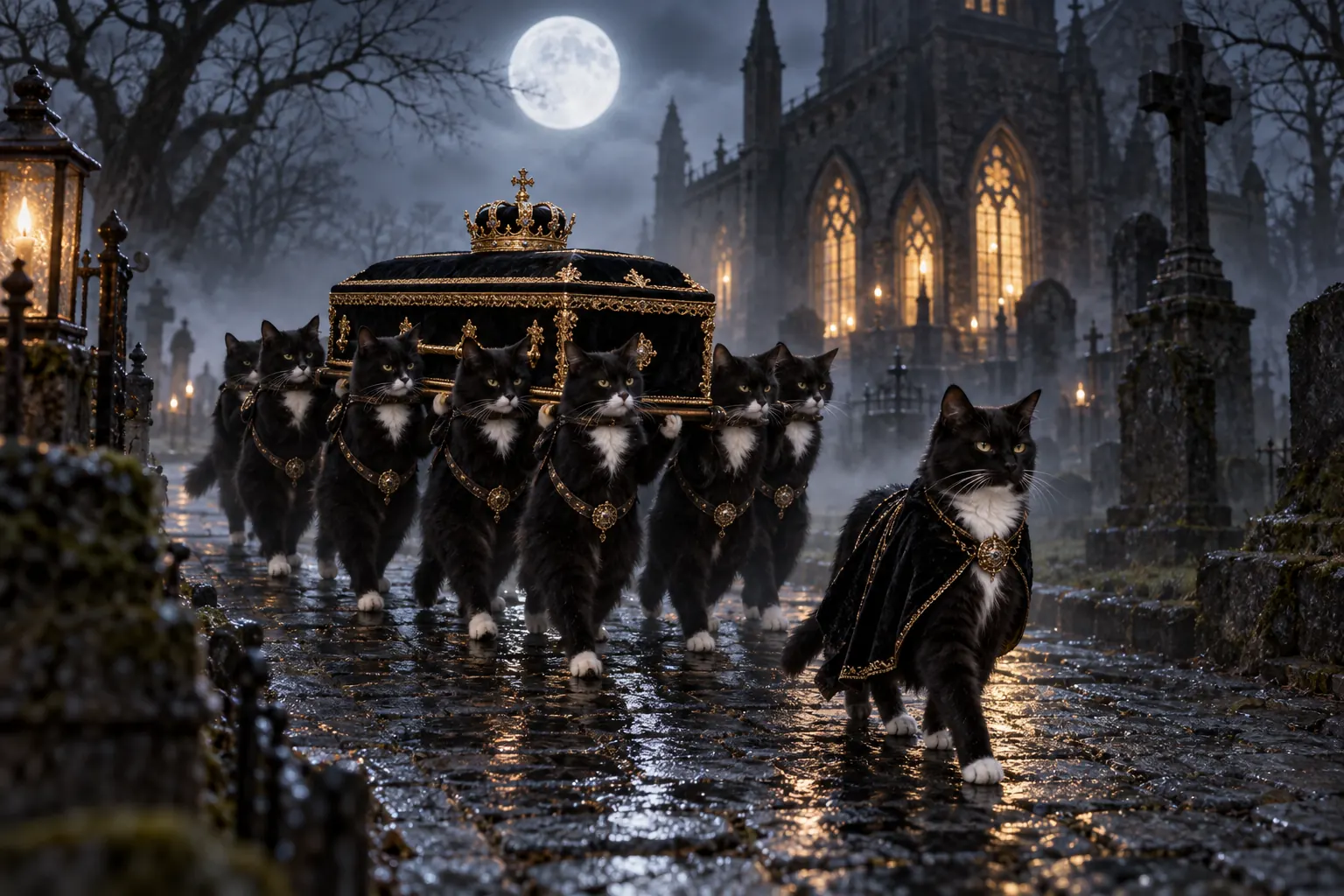
On a winter evening, a man digging a grave dozes off in a churchyard. A meow wakes him.
He looks up and sees something no one would expect at a funeral: nine black cats, each with a white patch on its chest. Eight carry a tiny coffin covered in black velvet. The ninth walks in front. A little gold crown rests on the coffin.
The cats stop. Their leader speaks. The man is told to deliver a message: “Tell Tom Tildrum that Tim Toldrum’s dead.”
He rushes home and tells his wife what happened. Their own black cat, Old Tom, has been sitting by the fire, listening with unusual interest. When the man repeats the message, Old Tom can no longer contain himself.
“What—old Tim dead! Then I’m the King o’ the Cats!”
And up the chimney he goes, never to be seen again.
This wonderfully strange old folktale, preserved by Joseph Jacobs in 1894, leaves us with nine mourners, one dead king, and a house cat who was apparently keeping his royal connections quiet.
But here’s a question: Had the old king finally used up all nine of his lives?
The tale never says. Still, those nine black cats open the door to a mystery people have been telling stories about for centuries.
Why Do Cats Have Nine Lives?
In real life, cats have just one life. “Nine lives” is an old saying about their knack for escaping danger, surviving close calls, and seeming to come back when all hope is lost.
That explains why the saying still makes sense. It doesn’t fully explain why people chose nine, or why cats became tangled up with witches, sacred powers, and the possibility of living more than once.
Search for “cat nine lives origin,” and you’ll find plenty of explanations. But the old stories lead to something far stranger than a simple answer.
The origin of the nine-lives saying remains a mystery. But the clues are much more entertaining than you might expect.
The Nine-Lives Saying Was Old Before Shakespeare
In 1546, English writer John Heywood included the line “a woman hath nine lives like a cat” in a collection of proverbs. It was a joke, not an explanation. Heywood didn’t need to explain what the cat part meant. The saying was already familiar.
By the time Shakespeare wrote Romeo and Juliet, it was familiar enough for a fight scene. Mercutio taunts Tybalt, calling him the King of Cats and threatening one of his nine lives, with the other eight to follow.
Another King of Cats. Another reference to nine lives. The scene is not the same story as the mysterious funeral, but it shows how easily cats, royalty, and extra lives could share the stage.
And the old writers left another clue. This one had claws—and possibly a human hiding inside.
When a Cat Might Be a Witch in Disguise
In William Baldwin’s Beware the Cat, written in the 1500s, a speaker connects the nine-lives proverb to a belief that witches could take the shape of cats nine times.
Now that is a very different kind of extra life. The cat isn’t escaping death. Someone is changing bodies.
Imagine hearing that story in a village where cats slipped silently between houses, watched people from dark corners, and sometimes seemed to appear out of nowhere. Was the animal at your door simply hoping for supper? Or did it know more than it should?
Farther north, Scottish Highland traditions described the cat sìth, or fairy cat. Folklore collector John Gregorson Campbell wrote of a creature as large as a dog, black with a white mark on its chest. Some storytellers considered it a fairy-like being. Others said it was a witch in cat form.
That white patch sounds familiar, doesn’t it? Every one of the nine cats in the funeral procession wore a white spot on its chest, too.
A small detail in two strange tales can make an ordinary black cat seem far less ordinary.
But not every culture saw a cat’s mystery as frightening. Some saw protection—and something close to the divine.
The Cats Who Walked Among the Gods
In ancient Egypt, cats were linked with Bastet, a goddess associated with protection and well-being. Cat statues stood as sacred offerings. Some cats were mummified and buried in places connected with her worship.
An animal that guarded a home from mice could also stand for a power watching over the household. That is quite a promotion for a creature that still expects someone else to fill its food bowl.
Egyptian stories also tell of a group of nine gods known as the Ennead. It’s easy to see why later storytellers might place those nine divine figures beside the cat’s nine lives. The link is an intriguing possibility to explore, even though ancient records don’t give us a neat answer to the proverb.
The bigger surprise is how many different lives people have given cats in their imaginations. One day a cat is a hunter. In another story, it is a witch, a fairy, or a guardian of the sacred.
And then there is the number itself. Not every cat in folklore gets nine.
Why Nine Lives Instead of Seven? Ask Don Gato
Nine has long felt like a special number in stories. Three is everywhere in folklore: three wishes, three trials, three chances. Nine is three times three, so it can sound like a grand final number. It’s an appealing reason for choosing nine, though no single explanation has won the argument.
And in Spanish tradition, cats often have seven lives instead.
One old song about Señor Don Gato makes the point better than any lecture could.
Don Gato is sitting on a roof when he receives exciting news about marriage. In his joy he falls, suffers terrible injuries, and is carried away for burial. Then the funeral procession passes through a place where fish are sold.
The smell of sardines reaches the apparently dead cat.
Don Gato comes back to life.
The song ends by reminding everyone that a cat has seven lives. Apparently, one of Don Gato’s was kept in reserve for an especially good lunch.
Think about that: in one tale a cat funeral brings news of a new king. In another, it brings a cat back from the dead. Different countries, different numbers, but the same irresistible thought: maybe the story isn’t over when we think it is.
The Real Cats That Seemed to Cheat Death
The old saying stuck for a reason. Cats really can survive things that leave people amazed.
They have a righting reflex that lets them twist their bodies in the air and often land feet-first. Their flexibility and quick reactions can help them escape trouble. But they can still be badly hurt, and a fall can be fatal.
In a 1987 veterinary study, researchers examined 132 cats injured in falls from heights. Ninety percent of the cats that received treatment survived. Many had serious chest injuries, broken bones, or other trauma. Their survival was remarkable, not magical—and certainly not a reason to test the proverb.
For a different kind of survivor, meet Simon.
Simon was the ship’s cat aboard HMS Amethyst in 1949. During the Yangtze Incident, the ship came under fire, and Simon was wounded. Even after suffering burns and shrapnel injuries, he returned to his duties, hunting rats that threatened the crew’s limited food.
His service earned him the PDSA Dickin Medal, an award for animal bravery. Simon’s story has no witch or fairy and no secret royal title. Its mystery is simpler: how can one small animal be so determined to carry on?
The fairy cat may change shape. Don Gato may rise for sardines. Simon simply kept going when life became difficult.
Perhaps that is another way to understand why the nine-lives saying refuses to die.
What If Nine Lives Means More Than Surviving?
Let’s return to Old Tom, the ordinary cat by the fire.
Until the man arrived with news from the churchyard, Old Tom was just a pet. A moment later, he was a king. He hadn’t died and returned. He hadn’t even left the room. Yet everything people thought they knew about him had changed.
What if that is part of the deeper charm of nine lives?
Across centuries and cultures, people have imagined cats as hunters, companions, protectors, witches, fairies, sacred animals, wandering survivors, and even royalty. They have been feared, admired, honored in art, laughed at, and loved. The same animal can seem completely familiar and utterly mysterious.
Maybe we give cats so many lives because we keep discovering another side of them.
That is our way of looking at the old saying, not its secret historical answer. And it leaves room for bigger questions. Why are we drawn to stories about escaping death? Why do we imagine animals returning to us? Is there something comforting about the thought that a life—or a bond—might not end as neatly as we fear?
The King of the Cats disappeared up a chimney. Don Gato returned at the smell of sardines. Simon held on through a war. And the cat beside you may be looking at you right now as if it knows something you don’t.
So why do cats have nine lives? In nature, they have one. In our stories, they have become far too mysterious to fit inside just one.
Now, what do you believe?

Also explore more mysterious tales and legends in our Cat Folklore and Superstition category.
Sources and Further Reading
- Joseph Jacobs, More English Fairy Tales (1894), “The King o’ the Cats”
- John Heywood, A Dialogue of Proverbs (first published 1546), transcribed text
- Folger Shakespeare Library, Romeo and Juliet, Act 3, Scene 1
- William Baldwin, Beware the Cat, 1584 edition transcription
- John Gregorson Campbell, Superstitions of the Highlands and Islands of Scotland (1900)
- The Metropolitan Museum of Art, Egyptian cat statuette and Bastet
- University College London, Egyptian creation deities and the Ennead
- Anatoly Liberman, Oxford University Press, “Numerals, especially the number nine”
- University of Castilla-La Mancha, Traditional folklore: “Estaba el señor don Gato”
- Whitney and Mehlhaff, “High-rise syndrome in cats,” JAVMA (1987)
- PDSA, Simon the ship’s cat and the Dickin Medal